


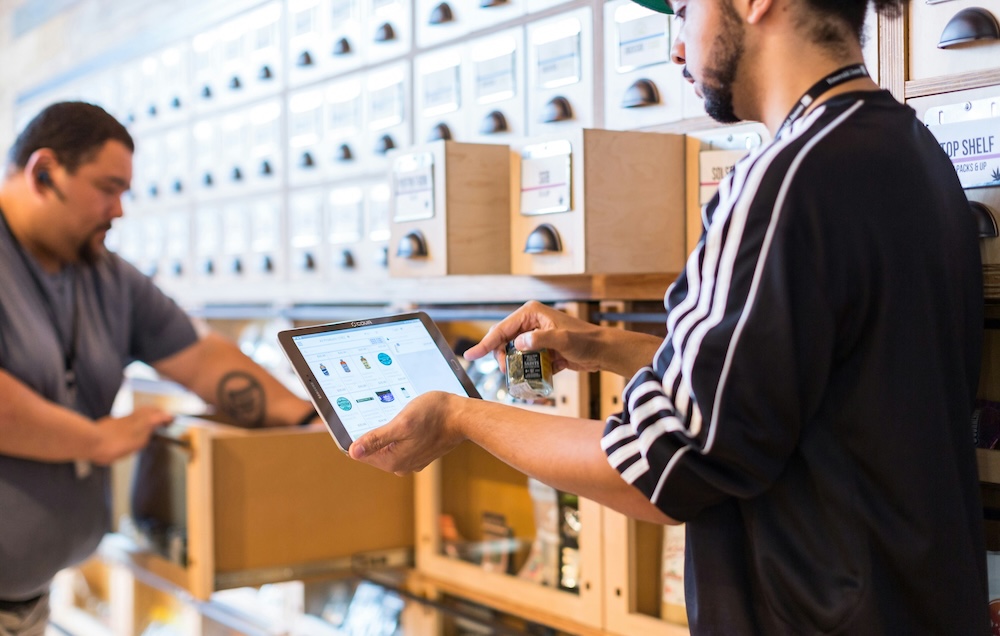
You may have heard of a new type of checkout experience that an increasing number of retailers are adopting. With RFID self-checkout technology, shoppers can place their desired items in a bin, where everything is scanned instantly. Items and prices are then displayed on a linked payment device, where buyers can quickly pay for their purchases. In today’s blog, we’ll discuss how an older technology—RFID chips—stands to reshape the future of retail.
What is RFID?
“RFID” is an acronym that stands for Radio Frequency Identification. Like a barcode, the technology is used to differentiate and identify various items. However, while a barcode is printed on a label or packaging material, and is read via an optical scanner, RFID utilizes what is called an “inlay” inside a label or plastic tag. It is scanned by a reader that uses radio waves.
The big advantage which RFID has over barcodes is that it does not require line-of-sight. The information contained on the RFID tag or label can be interpreted by the reader even if it is covered by something, far away, or buried inside of a box. That’s why it’s possible for retailers using the technology to scan an entire basket of items in a few seconds, without holding individual items under a scanner.
Common Applications for RFID
RFID Inventory Tracking – In-store
One of RFID’s most useful applications is tracking inventory. For example, if RFID readers are installed in a store’s front or back doors, they can read what has arrived and update the store’s inventory system. If a fixed RFID reader is used at the door of a stockroom, it can automatically detect when an employee takes merchandise out to the showroom, and update the inventory system accordingly.
Finally, when the merchandise is sold, scanning it at the checkout can trigger an action to replenish stock so the store does not run out of that product. Retail owners can therefore always know what is in their inventory, and never run out of a high-demand product.
RFID Inventory Tracking – Warehouse
Of course, tracking inventory at the store level is just one aspect of inventory management. RFID is also commonly used to track what’s coming in and out of warehouses and where items are being stored. For example, RFID readers can quickly count merchandise as it is unloaded from a supplier truck. It can track where the item lives within the warehouse, and can again track the item as it is loaded on a new truck for local delivery. All these activities can be logged in the inventory system, helping the warehouse management stay up-to-date on the merchandise’s whereabouts.
This is exceptionally helpful when it comes to food safety. Knowing where food came from, where it is, and how long it has been in transport can help prevent spoilage and food waste.
Cycle Counting with RFID
Most retail stores practice “cycle counting,” or counting a small amount of inventory on a regularly scheduled basis. Unlike a “full physical count” which requires shutting down operations to count everything, cycle counting allows businesses to maintain accuracy while remaining open.
RFID systems can help make cycle counting much easier—essentially instantaneous. For example, say there is a display of T-shirts, each one equipped with an RFID label. A store associate could simply wave a handheld RFID reader over the display, and instantly count how many shirts are on it. This makes it easier to check the stock frequently, and to have a consistently accurate understanding of what’s on display and what isn’t.
Loss prevention with RFID
RFID tracking can also help with loss prevention. To use the example above, let’s say the shop owner starts the day with 30 shirts. No shirts sell, but at the end of the day, 29 are scanned by the RFID reader. That means that the store has experienced a loss, either from shoplifting or another internal error. RFID readers can also be installed in entry and exit points, and used to detect and flag shoplifting just like EAS (Electronic Article Surveillance) systems do now.
Other RFID Uses
In addition to the uses described in this article, RFID can be used for many other purposes. Here are some other common applications:
- Asset tracking: Used by the military since the 1940s, and more widely in the private sector since the 1970s, RFID labels and tags can be affixed to any asset that needs to be tracked and counted. This may include tools, supplies, or equipment.
- ID badges: Many employee IDs which grant building access contain RFID inlays.
- Quality assurance and counterfeit prevention: RFID is commonly used in the pharmaceutical and medical industries to track medications, compounds, and devices throughout the manufacturing and delivery process to ensure quality and compliance.
- Pets and livestock tracking: When your pet gets “chipped,” that “chip” is actually a tiny RFID tag. When you “register” that chip, the information about you and your pet is entered into the database. Veterinarians can then use an RFID reader to identify the animal. Farmers also commonly “chip” their heard animals with RFID tags to enable easier tracking and counting.
- Toll systems: If you have ever used a toll pass device that allows you to pay a toll without stopping, that pass is actually—you guessed it—an RFID tag.
How can my business adopt RFID technology?
If you’re interested in adopting RFID technology, here’s a structured, phased approach you can follow.
- Assess your needs and set goals. Identify operational “pain points,” that you currently have, like slow inventory counts or high shrinkage. Establish measurable objectives, like a 50% reduction in cycle count time.
- Perform a site survey: Evaluate your physical environment to determine if it’s compatible with RFID technology. You will need to place readers and antennas in areas away from metal or liquid interference.
- Explore your options: There are many RFID tools available, and the right one for you will depend on your needs and your environment. Passive UHF tags are typically used for high-volume inventory, while active tags are better for long-range asset tracking. Do some research to determine what your options are and how they differ.
- Test the RFID technology: Instead of deploying a facility-wide rollout, test it out on a small area first. This could be a single booth or a single product.
- Implement the new solution: Once you’re confident that the system delivers positive outcomes, scale the hardware installation to the rest of the store or facility. Provide comprehensive staff training on new tagging and scanning procedures.
More questions? Ask SSI Packaging!
SSI Packaging Group is a family-owned distributor of industrial packaging, shipping supplies, and marking and coding solutions. Since 1967, we have helped businesses across the Mid-Atlantic and Southeast “pack and track” their products. If you need help navigating RFID chips, 2D barcodes, or anything else, we’re here to help!