


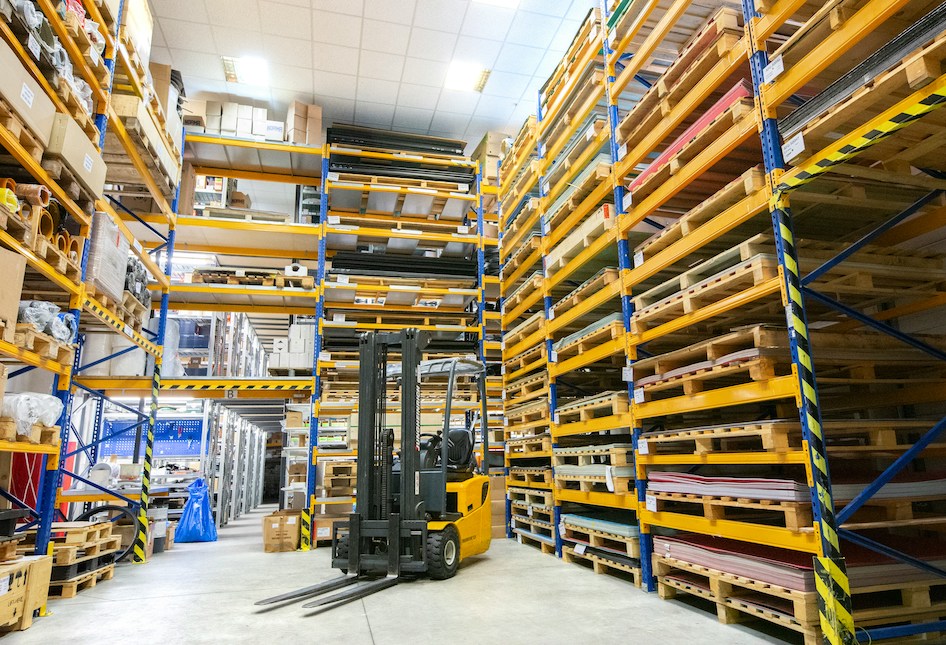
Warehouses tend to be busy and hazardous places, with workers, drivers, and objects constantly in motion around one another. Ensuring that your facility has the best warehouse material handling equipment can go a long way toward keeping everyone safe and productive. Below are some tips on selecting the best large material handling tools for your facility and your business!
Pallet jacks
As the name implies, pallet jacks make it easy to transport heavy materials stacked on pallets. They feature two twin forks that slide beneath each pallet. A manual pallet jack requires the user to move the handle up and down with pumping force, which creates a hydraulic action that lifts the pallet upwards.
When buying a pallet jack, first determine the heaviest loads you’ll regularly lift and move. Then, choose an option with a weight capacity that comfortably exceeds that maximum. In addition, ensure that the pallet jack will be able to accommodate the pallet sizes you will be transporting. Finally, look for safety features like reliable braking systems, overload protection, and ergonomic handle designs to reduce operator strain. The safer your employees are, the more efficient your operation will be.
Hand trucks
Like pallet jacks, hand trucks make it easier to transport large or heavy items throughout a facility. A hand truck has a metal frame, a toe plate, and a handle. The operator slides the toe plate under an object and tilts the handle back, in order to easily wheel the object to another location. Hand trucks can move smaller objects than pallet jacks, and do not utilize hydraulic action.
When selecting a hand truck, first assess the types of loads you’ll be moving. As with pallet jacks, you should choose a model with a capacity that comfortably exceeds your heaviest anticipated loads. For occasional, light-duty use, a basic model might suffice. If you think you will require heavy, daily use, though, it’s wise to invest in a more robust and ergonomic option.
Platform trucks
A platform truck is simply a flat sheet of metal with wheels on the bottom and a handle on one end, allowing the operator to push or pull the truck. Despite the simple design, though, platform trucks are very robust—some models can hold more than 2,500 lbs.! When operating a platform truck, the operator must be careful to push the truck, and not the merchandise that is resting on top of it. Otherwise, the material will fall and possibly break.
When purchasing a platform truck, you should first determine the maximum weight you’ll regularly transport, and choose a model with a capacity that comfortably exceeds this. Overloading can lead to material damage, injuries, or both. You should also consider the size and shape of the items you will need to move. Large, bulky items will benefit from a wider and longer platform, while irregularly-shaped items might require specific features, like side rails, to keep them in place.
Tilt trucks
A tilt truck, also known as a tilt-tray truck, is a type of cart that can be hydraulically or gravity-assisted to tilt, allowing for easy and safe loading and unloading of cargo without the need for ramps. Tilt trucks are another rather simple piece of equipment that have drastically improved material handling across a wide variety of industries.
Since tilt trucks are usually sold by volume, consider the amount of material you will need to transport per load, in gallons, bushels, or cubic feet. Ensure that the truck can handle the maximum weight of the materials you’ll be loading into it, especially in the case of dense materials, like concrete or stone. Look for durable, seamless material that resists cracking, chipping, denting, and rusting. High-density polyethylene (HDPE) is usually the preferred choice for its strength and chemical resistance.
Collapsible basket trucks
Collapsible basket trucks are versatile material handling solutions that are ideal for facilities with limited space. Their primary advantage is their ability to collapse, significantly reducing their storage footprint when not in use. They also typically have a removable cloth or vinyl lining which can be washed every so often.
When buying a collapsible basket truck, look for a balance of durability, ease of use, and effective space-saving. First, ensure that the truck can collapse and expand easily, without excessive force or fiddling. Next, ensure that the mechanism locks securely in both the open (extended) and closed (collapsed) positions. This will prevent accidental folding during use, or unfolding during storage/transport. Finally, check the basket truck’s dimensions when it is folded, to ensure it will fit in the area where you would like to store it.
Stretch wrap
Stretch wrap, also known as stretch film or pallet wrap, is a highly stretchable plastic film, usually made from low-density polyethylene (LLDPE). It’s designed to be wrapped tightly around items, particularly on pallets, in order to keep them securely bound together during shipping and storage.
Stretch wrap is available in a wide array of thicknesses, material types, and sizes, so choosing one can be very overwhelming. To reduce confusion, focus on the size, shape, and weight of the loads you will be moving. The heavier your loads, the stronger your stretch wrap gauge (thickness) will have to be. Loads that are uniform, like pallets full of same-sized boxes, will be fine with a lower gauge, will irregular loads full of sharp corners and edges will require more durability.
Strapping
Material handling strapping, also known as banding, is a strong, flat material used to bundle, reinforce, or secure items for storage and transportation. Its primary purpose is to maintain the integrity and stability of loads, preventing shifting and damage during movement.
To choose the best strapping option for your needs, first assess your load requirements. Heavy, stable loads (e.g., steel coils or construction materials) will often require strong steel or high-tensile polyester strapping. Lighter loads (like newspapers, or textiles) can typically use polypropylene. You should also consider the environment that will store and transport your materials. For example, steel strapping can rust in outdoor or high-humidity environments, so polyester and polypropylene would be the preferred choice.
Edge protectors
Edge protectors, also known as corner protectors, edge guards, or angle boards, are essential packaging and material handling accessories. These are designed to safeguard the vulnerable edges and corners of products, packages, or palletized loads during storage, handling, and transportation. They are also help prevent strapping from cutting into the materials being transported.
When purchasing edge protectors, first consider the overall shape and vulnerable points of your loads. L-shaped (corner boards/angle boards/V-board) made from cardboard or plastic are the most common choice for standard boxes, pallets, or items with 90-degree angles. U-shaped (U-channel) protectors are ideal for protecting the long, flat edges of items like sheet goods, glass panels, or mirrors. Some items like coils, rolls, or pipes will require flexible or notched edge protectors that can conform to their contours.
Get everything your facility needs from SSI Packaging!
If you are looking to purchase material handling equipment in Richmond, VA or the surrounding areas, call SSI Packaging. We offer everything your manufacturing business needs to run smoothly, efficiently, and safely. From packaging and shipping supplies, to industrial marking and coding solutions, we offer everything you need to pack and track your image. For more information, click here.